Revenue is a function of both price and volume. In turbulent times, many companies react to uncertainty by focusing on growing volumes as the primary driver of revenue growth. This is typically achieved by lowering prices, especially in recessionary periods when demand is more price elastic. However, during a recession, brands are often better advised to focus on strategies that increase volume without reducing prices. While this requires creativity and discipline, it is the best way to sustain long-term revenue growth.
Below are several potential consequences of lowering how much you charge for your product or service.
Lowering prices shrinks profit margins, and not just in the short term.
Adjusting pricing in response to falling demand is problematic because once a brand reduces prices, it becomes difficult to return to historical levels, especially after the market adjusts. According to the Harvard Business Review, producer prices dropped by nearly 8 percent during the last recession and took almost two years to recover.
Lower prices also reduce profit margin if the increase in sales volume does not fully offset the price decrease. The example below illustrates this impact.
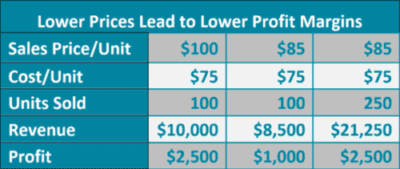
Example: Impact of price reductions on profit marginIf a product priced at $100 generates $2,500 in profit at 100 units sold, a 15 percent price reduction to $85 results in a 60 percent drop in profit if volume remains flat. To recover the original profit level, sales volume would need to increase by 150 percent, simply to break even.
Lowering prices can negatively impact brand perception, especially for market leaders.
Pricing signals value. When prices are reduced, customers often begin to perceive the brand differently, and once that perception shifts, it is difficult to reverse.
Macy’s provides a cautionary example. Once positioned as an upscale department store, sustained price reductions reshaped customer perception. Today, the brand is widely viewed as a discount retailer, a shift from which it is unlikely to fully recover.
Market-leading brands do not need to follow discount pricing strategies. Customers are often willing to pay more for reliability, quality, and trust, which is why strong brands historically resist price-matching tactics.
Lower prices rarely result in long-term volume gains when matched by competitors.
Price reductions may create short-lived volume increases, but competitors often respond quickly. When price cuts are matched across the market, industry-wide margins decline and volumes typically return to historical levels.
The result is lower profitability across the industry, with no lasting competitive advantage.
Periods of slowing demand present an opportunity to reassess how value is delivered, not just how it is priced. Sustainable revenue growth is driven by operational efficiency, improving execution discipline, cost structures, and decision-making rather than relying on price reductions.
Organizations that invest in operational efficiency during uncertain times are better positioned to protect margins, strengthen brand value, and accelerate growth when demand returns.
Interested in